
Do I Need a CPA?
- March 17, 2026
- Posted by: CKH Group
- Category: Tax tips
“Do I Need a CPA?” A Practical Guide for Tax Season
Every tax season, millions of Americans ask the same question: Do I need a CPA, or can I file my taxes myself?
The simplest answer is “it depends.” Most tax professionals will agree that the decision usually comes down to one factor: how complex your tax situation is. However, this raises a more frustrating question:
What exactly does a “complex tax situation” look like?
Some tax situations are essentially mechanical. You enter the information, the software calculates the result, and you file. Others require a deeper understanding of how tax rules interact, what documentation matters, how income should be categorized, and whether certain deductions or elections are appropriate.
The challenge is figuring out where that line actually falls. That’s why we’ve prepared a practical guide to help you evaluate your situation and answer the age-old question ‘do I need a CPA?’.
What Makes a Tax Situation Complex?
Tax complexity isn’t necessarily about how many forms you must fill out. Instead, complexity usually comes from situations that expose you to additional tax regulations, filing obligations, or tax-planning opportunities.
For example, if you file taxes in multiple states, you may be subject to different tax rules in each jurisdiction. That means additional forms, additional compliance requirements, and potentially different deductions or credits to consider.
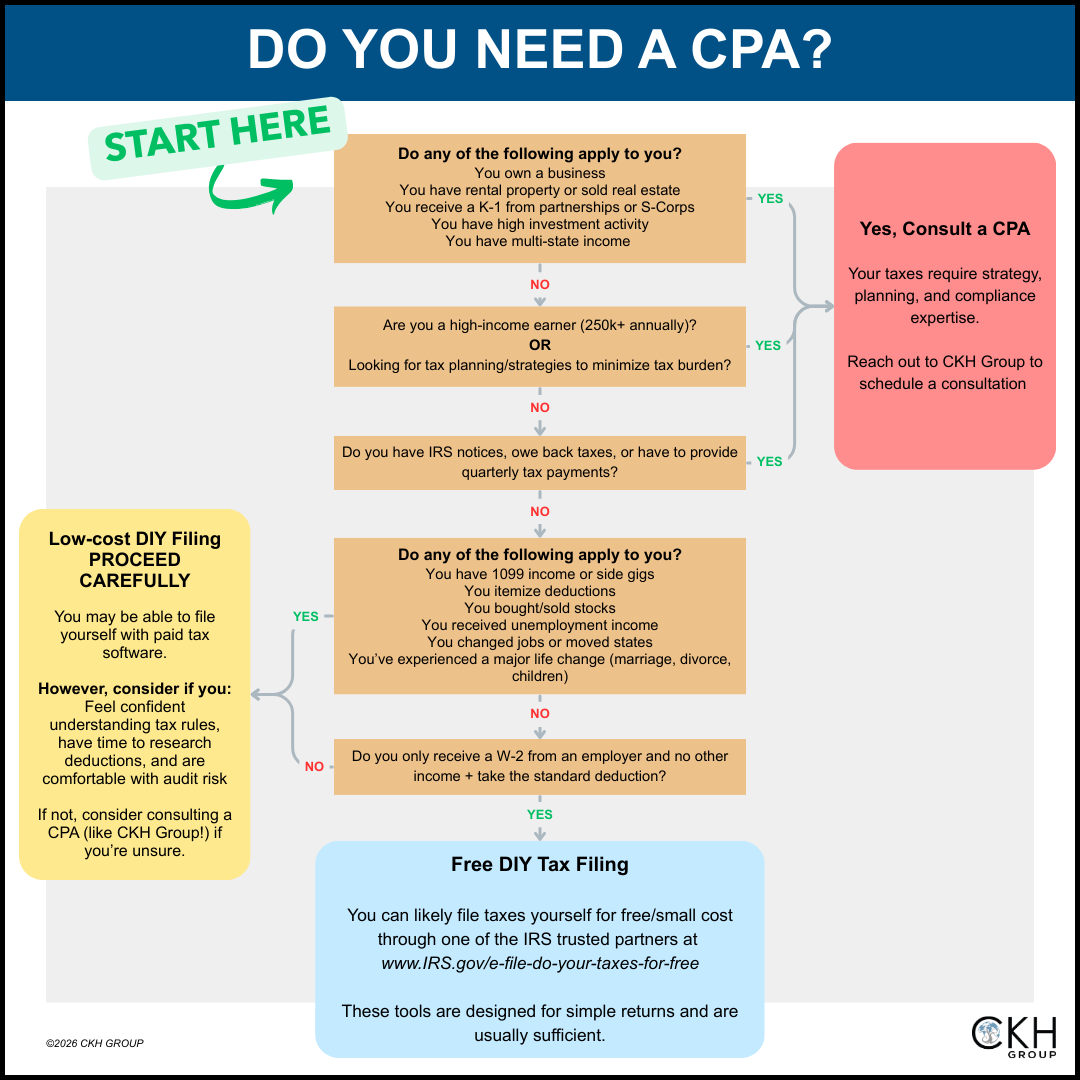
In general, complexity tends to arise when your financial life includes things like:
- Multiple income sources
- Business ownership
- Investments or real estate
- Multi-state filing obligations
- Itemized deductions
- Opportunities for tax planning
In the sections below, we’ll walk through which of these situations may still be manageable with tax software and when it may make sense to work with a CPA. The below flow chart will give you a good idea of where your situation falls.
Can I File my taxes for free?
Many taxpayers qualify for free filing tools through the IRS and other programs.
The IRS Free File program allows eligible taxpayers to file federal returns for free through partner software if income falls below certain thresholds. For 2025 returns, IRS free file guided software is available to taxpayers with Adjusted Gross Income (AGI) of $89,000 or less. It is important to note that each partner software may have their own additional eligibility rules.
Outside of the IRS partner software, several popular commercial tax preparation companies also offer free versions. However, these versions are typically limited to the most basic returns with little variation in income or deductions.
In general, all these free options are best suited to individuals who only receive a W-2 from an employer, have no other income, and take the standard deduction. Some free tools can accommodate more complexity depending on eligibility, but most are designed for simple tax situations.
Situations Where DIY Tax Filing May Still Work
As you start to add on complexities here and there, the line becomes blurred as to whether or not you need a CPA.
For example, if you:
- Have 1099 income or side gigs
- Itemize your deductions
- Bought or sold Stocks
- Receive unemployment income
- Changed jobs or moved states
- Experienced a major life change (marriage, divorce, children, etc.)
In all of these situations, it is usually possible for you to do your taxes yourself, but with some added caveats. For one, those free options may no longer cut it- you might have to upgrade or find low-cost software that can accommodate your additional complexities.
The main question you should pose; should you do your taxes yourself? Ask yourself: Do I feel confident understanding tax rules? Do I have time to research deductions? Am I comfortable with potential mistakes or audit risk?
If the answer is no, it may be worthwhile to consult a reputable CPA instead of risking penalties for unintentional errors.
When Should I Work with a CPA?
Certain financial situations introduce complexity that even the best tax software alone may not be able to accommodate. This is because tax software can struggle with nuances and usually does not provide strategic or qualified planning and guidance. If any of the following apply to you, consulting a CPA is often the safest and most strategic option.
1. You Own a Business or Receive K-1 income
Business owners face a much more complicated tax environment than employees. A CPA can help with:
- Deductible expenses
- Entity structuring and compliance
- Estimated tax payments
- Multi-state obligations
Business taxes often require strategic planning, not just form preparation. CPAs can analyze your situation and help ensure you are paying the correct amount of tax.
Additionally, K-1 income from partnerships or S-corporations can add complexity because you may need to correctly report pass-through items.
2. You Have Investment or Rental Income
If your financial life includes more than a standard paycheck, your tax return can quickly become more complex. This includes rental property income or real estate sales, stock or investment gains/losses, or other major investments or income streams. These situations require careful reporting and may involve specialized tax rules that are easy to misunderstand without professional guidance.
3. Your Income Spans Multiple States or Multiple Sources
Because each state has its own local tax laws, regulations, and opportunities for tax saving, if your income comes from multiple states or is a mixed bag of investments, rental properties, side gigs, royalties, or other sources of income, traditional tax software may not fully account for all filling obligations or planning opportunities. Consulting a CPA is especially important if your goal is to reduce your tax liability across these areas.
4. Your Income Is High/You’re a High Net Worth Individual
Higher income often means more planning opportunities and more potential pitfalls. Even if your income source is straightforward, consulting a CPA can help you explore opportunities to reduce your tax liability, especially if you plan on making purchases or investments in the future. Professional tax advisors stay current with evolving tax laws and planning strategies, helping identify deductions or credits that software alone might miss.
5. You’re Dealing with the IRS
If you’ve received IRS notices, owe back taxes, or need help resolving tax issues, working with a CPA can be extremely valuable, and often necessary to understand the compliance requirements involved.
CPAs (an enrolled agents or attorneys) are qualified to represent taxpayers before the IRS and can assist with audits, collections issues, and appeals.
A Simple Rule of Thumb
Not every situation necessitates involving a CPA, but a helpful rule of thumb is this:
Tax software helps you prepare and file your return.
A CPA helps you plan, strategize and stay compliant.
So, if your tax situation is simple and does not require strategizing or a strong understanding of compliance, filing yourself may be a perfectly reasonable choice
But if your finances include business income, investments, real estate, or complex tax issues, working with a CPA can provide clarity, strategy, and peace of mind. At the end of the day, the goal isn’t just to file your taxes. It’s to file them correctly and strategically.
If you’re still unsure whether your situation requires professional guidance, reach out to CKH Group. Our team can help you evaluate your options and provide an estimate for professional tax preparation.
The above article only intends to provide general financial information and is based on open-source facts, it is not designed to provide specific advice or recommendations for any individual. It does not give personalized tax, financial, or other business and professional advice. Before taking any form of action, you should consult a financial professional who understands your particular situation. CKH Group will not be held liable for any harm/errors/claims arising from the articles. Whilst every effort has been taken to ensure the accuracy of the contents, we will not be held accountable for any changes that are beyond our control.