
The Psychology of Money: Business Decisions
- April 7, 2026
- Posted by: CKH Group
- Category: Blog
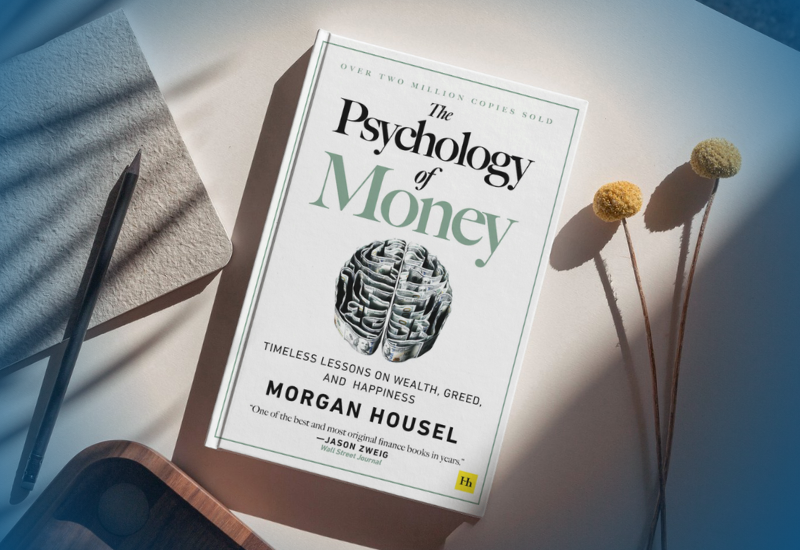
Reflecting on The Psychology of Money and how it affects Business Decisions
Harry Catrakilis gives an analysis of a recent book he was recommended: The Psychology of Money by Morgan Housel. He breaks down how one of Housel’s examples surrounding lottery tickets highlights how we make better Business Decisions.
“A few weeks ago, I traveled with my wife Helen to South Africa for the soft launch of her debut novel, Under an African Sky. February is a great time to visit, and the trip itself was both rewarding and energizing. Beyond the event, I had the chance to spend time with my younger sister, Elpi, and her twin boys, which made the experience even more meaningful.
During the trip, Elpi recommended a book to me: The Psychology of Money by Morgan Housel. I’ll admit, I’m not typically drawn to financial or self-help books. Many tend to come across as overly prescriptive and detached from real-world experience, if not a bit pompous. But if my sister recommends it, I know I have to read it, and I found that certain ideas aligned closely with what I’ve seen firsthand in both life and business.
One concept in particular stuck with me: our financial decisions are not driven purely by logic or data, but by our personal experiences. As Housel puts it, “Your personal experiences with money make up maybe 0.00000001% of what’s happened in the world, but maybe 80% of how you think the world works.
That idea has significant implications. It highlights not just how individuals make financial decision, but also how these decisions are made within businesses.
Housel illustrates this through an example that, at first glance, seems irrational: lottery spending. Data shows that lower-income households spend disproportionately more on lottery tickets, often despite having limited financial safety nets. “The lowest-income households in the USA on average spend $412 a year on lotto tickets. Four times the amount of those in the highest income groups,” Housel details.
On the surface, this looks like poor financial decision-making. But when you consider the context, such as lack of access to opportunity or limited upward mobility, the logic becomes more apparent.
In that light, purchasing a lottery ticket is less about probability and more about possibility. It’s not a financial strategy; it’s a psychological one. It represents access to a future that otherwise feels unattainable. Housel explains: “Buying a lottery ticket is the only time in our lives we can hold a tangible dream of getting the good stuff you already have… We are paying for the dream, and you may not understand because you are already living the dream.”
It’s a poignant narrative that really makes you stop and be grateful.
Housel goes on to say that very few financial decisions are made purely on spreadsheets. In reality, these decisions are made at the dinner table or in a company meeting.
I agree with Housel. From my experience, financial parameters are rarely the sole driver of a successful business decision. Decisions are shaped by perspective, experience, and both real and perceived opportunity. And understanding that is key.
Because on one hand, this is not necessarily a bad thing. Risk is a necessary part of business. The one who wins the lottery is certainly not going to regret buying a ticket. As my son likes to say, fortune favors the bold.
But on the other hand, without some level of financial discipline and due diligence, boldness can quickly turn into recklessness. There’s a reason the opposite cliché exists: a fool and his money are soon parted.
The takeaway, at least for me, is to strike a balance.
Yes, most decisions are not purely analytical. They are shaped by instinct, bias, and experience. And yes, taking risks is necessary. But understanding why you are making a decision matters just as much as the decision itself.
Housel’s example of the lottery ticket captures this perfectly. Risk, hope, and ambition are all part of the equation. But without awareness and discipline, those same instincts can lead to poor outcomes.
Because in business, as in life, both sides of that equation matter.” -Harry Catrakilis
The above article only intends to provide general information and reflection. It is not designed to provide specific advice or recommendations for any individual. It does not give personalized tax, financial, or other business and professional advice. Before taking any form of action, you should consult a financial professional who understands your particular situation. CKH Group will not be held liable for any harm/errors/claims arising from the blog. Whilst every effort has been taken to ensure the accuracy of the contents, we will not be held accountable for any changes that are beyond our control.
About the Author

Harry Catrakilis has over 30 years of experience in the practice of public accounting, corporate financial management, and investment banking. He was managing partner of CKH from 2003 until summer of 2018 when main operations were passed on to CEO. This blog was written by and is the candid reflections of Harry Catrakilis.