
4 Tips to Budgeting for Business Growth
- October 20, 2026
- Posted by: CKH Group
- Category: CEO Blog

CKH Group CEO Kate Kudrenko talks about the importance of effective budgeting and shares four key principles for business leaders, from balancing ambitious growth goals with conservative spending to encouraging strategic investments, financial accountability, and company-wide collaboration.
“As an accounting firm, we spend a lot of time helping our clients manage their finances, plan for the future, and make informed business decisions. But, of course, we also have to manage our own financials, and over the years we’ve learned a few things about making this process more efficient.
Good budgeting is not just about getting the numbers right. It’s about making sure those numbers encourage the right business decisions.
As we work through our own budgeting season at CKH Group, there are a few principles I’ve been thinking about.
1. Keep the Process Simple and Strategic
Before getting into the bigger strategic questions, let’s start with the mechanics.
A budgeting process doesn’t need to be overly sophisticated to be effective. In fact, the more complicated the process becomes, the easier it is to lose sight of what we’re actually trying to accomplish.
A few practical rules have helped us:
- Use one standard template. Keep it simple, consistent, and easy to use. The more flexibility you give people, the more creativity you get back (and not necessarily the kind you wanted!).
- Have a system. It doesn’t have to be expensive or complicated. Even a locked Excel template with a structured upload into QuickBooks Online can work well for many businesses. Consistency matters more than sophistication.
- Start early. There will be revisions. And more revisions. The budget is never final until its Final_Updated_v7_FINAL.xlsx. The sooner you begin, the more time you have to work through the decisions that actually matter.
These steps make the budgeting process easier to manage. But they’re really just the foundation.
The more interesting questions come afterward: How ambitious should our revenue projections be? When should we commit to additional operating costs? How do we account for investments that benefit multiple departments?
Those are the decisions that determine whether a budget actually supports the business.
2. One Number Shouldn’t Have Five Jobs
One interesting idea I’ve come across while reading about budgeting is just how much responsibility we tend to place on a single number.
Think about how businesses use their annual budgets.The same number might serve as a revenue target, a financial forecast, an authorization to spend money, a measure of performance, and even the basis for employee bonuses.
That’s a lot of responsibility for one Excel cell!
The problem is that these five purposes are fundamentally different.
- Targets should stretch us.They should encourage ambition, motivate teams, and reflect what we’re working toward.
- Forecasts should reflect reality.They should represent our best estimate of what we actually expect to happen, even when that estimate falls short of our goals.
- Spending decisions should reflect what we need and can afford.Just because we’ve included an expense in the budget doesn’t necessarily mean we should commit to it immediately.
- Performance evaluations should consider context.A target set 12 months ago shouldn’t be the only measure of whether someone performed well. Markets change, circumstances evolve, and sometimes the right business decision means deviating from the original plan.
- Bonuses should reward actual performance.We want to incentivize results, not someone’s ability to negotiate a more achievable budget during the planning process.
When we try to accomplish all five things with one number, budgeting can become less about running the business and more about negotiating expectations. Someone might intentionally underestimate revenue to make their targets easier to achieve. Another department might overestimate expenses to protect its spending flexibility.
Neither behavior necessarily helps the company. By separating these purposes, we can build a budgeting process that encourages transparency, accountability, and better decisions.
3. Conservative Budgets, Ambitious KPIs
I’m a big believer in business growth. I also believe that businesses need to invest in people, technology, marketing, and other resources to make that growth possible.
But there’s an important difference between planning for growth and committing to expenses based on growth that hasn’t happened yet.
Consider a common budgeting scenario.
A company announces, “We’re going to grow 30% next year!” So, we budget for 30% revenue growth. Then we add the employees, software, marketing expenditures, and other operating costs we expect to need to support that growth.
January arrives. The costs show up right on time.
Revenue? Well, sometimes that takes a little longer.
And suddenly, a few months into the year, leadership is having restructuring conversations that nobody wanted to have. This is why I favor a simple principle: Keep the budget conservative. Keep the KPIs ambitious.
We can absolutely set a goal of 30% growth. We can establish performance incentives that reward our teams for achieving it. We can plan for the additional resources we’ll need as the business expands. But that doesn’t mean we need to commit to every dollar of additional operating expense on January 1.
Instead, we can make thoughtful investments, monitor our performance, and add resources as growth materializes. If the business grows faster than expected, fantastic. We reforecast, adjust our plans, and continue investing.
Of course, some investments need to happen before revenue follows. The goal isn’t to avoid spending or take an overly cautious approach to growth. It’s to distinguish between strategic investments that create opportunities and operating costs that depend on those opportunities becoming reality.
I would much rather add costs because growth happened than cut costs because we hoped it would.
4. A Rising Tide Lifts All Boats
Another budgeting challenge comes from how businesses allocate costs and measure profitability across departments.
At CKH Group, we maintain separate budgets and profit and loss statements (P&Ls) for different business units, including tax, audit, and consulting. This is important. Each business unit should understand its financial performance, manage its resources responsibly, and take ownership of its profitability.
However, we also follow the principle that P&Ls should reflect reality, not drive internal competition.
Imagine a new technology platform that could improve efficiency across several departments. Or a strategic initiative that creates opportunities for the company as a whole but requires one business unit to take on most of the initial expense.
If the first question is, “Whose P&L will this hit?” we may already be approaching the decision from the wrong perspective. The first question should be, “Does this investment make sense for the company?”
We still need to understand the costs, expected benefits, and financial implications. But we shouldn’t discourage good company-wide investments simply because they might temporarily reduce one department’s reported profitability.
For certain strategic investments that leadership wants to encourage, one approach is to account for those costs separately, below the business unit’s operating performance measure, rather than penalizing the department for supporting a broader company initiative.
This doesn’t mean the costs disappear or that departments should be exempt from financial accountability. The investment still affects the company’s overall financial results. It simply means recognizing the difference between a business unit’s underlying operating performance and investments made for the benefit of the organization.
After all, a rising tide lifts all boats.
We want our business units to succeed individually, but we also want them to collaborate, share opportunities, and make decisions that strengthen CKH Group as a whole. Our budgeting approach should encourage that behavior, not work against it.
Final Thoughts: Budgeting Beyond the Spreadsheet
All of these principles come back to one idea: A budget should help leadership make better decisions, not replace leadership’s judgment. Circumstances change, priorities shift, and sometimes the best decision for the business means deviating from the original plan.
Budgeting will probably never be everyone’s favorite activity, but it’s an opportunity to think critically about where we want the company to go, what we’re willing to invest in, and how we define success. Ultimately, the goal isn’t to produce a perfect spreadsheet. It’s to build a stronger business.” -Kateryna Kudrenko
The above article only intends to provide general information and reflection. It is not designed to provide specific advice or recommendations for any individual. It does not give personalized tax, financial, or other business and professional advice. Before taking any form of action, you should consult a financial professional who understands your particular situation. CKH Group will not be held liable for any harm/errors/claims arising from the blog. Whilst every effort has been taken to ensure the accuracy of the contents, we will not be held accountable for any changes that are beyond our control.
About the Author
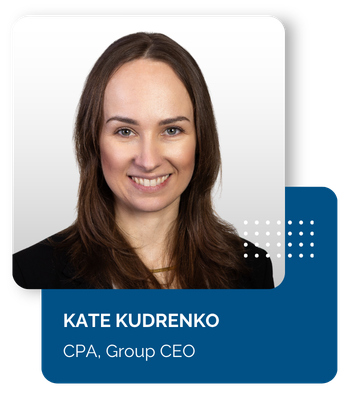
Kate Kudrenko has over 15 years of experience in M&A, tax accounting, and compliance and holds a CPA in the state of Georgia. Since joining CKH in 2016 Kate has been involved in every area of CKH business. In 2025 she was promoted to the role of Chief Executive officer, where she is responsible for day-to-day operations, strategic execution, and overall leadership of CKH Group. This blog was written by and is the candid reflections of Kate Kudrenko.