
End of Year Decision Making
- November 25, 2025
- Posted by: CKH Group
- Category: Blog

Time to Face the Music: Racing Towards End of Year Decision Making
How do businesses navigate difficult end of year decision making? Harry Catrakilis tackles this difficult subject with two examples he’s seen in the business that can be tricky for leadership to approach. He ties back to his previous observations on how to reward high achieving employees and salary vs. compensation.
“This time of year has always carried a certain amount of anxiety for me. The holidays for many are a time of celebration, but in business it is also the time where you are truly held accountable. It’s when budgets are finalized, bonuses and promotions are decided, and every leader must balance organizational needs with individual expectations. In short, this is when leaders must ‘face the music’.
Over the years, I’ve gone through this cycle enough times to recognize a few recurring patterns; situations that can make year-end decisions particularly challenging. Here are two examples that tend to resurface in different forms, year after year.
1. When Strong Performers Don’t See Results
You might have an exceptional employee; someone who consistently exceeds expectations, makes your life easier, and delivers beyond what’s asked. But great employees also have expectations of their own- they expect their leader to make successful strategy that they can execute on. So what happens when a strong employee ‘hitches to the wrong wagon’? What happens when their high performance falls flat under the poor performance of their boss, team, or company?
Imagine as a leader you’ve built a strategy that, on paper, should lead to growth: attending multiple trade shows to build business, running a high budget campaign, or launching a new service. Your employee embraces the concept and does their part, executing perfectly: they handle logistics, set up, engage customers, and do everything right. Yet, if leadership doesn’t follow through, for example, the leader cannot get the delivery organization to produce the results of all the hard work, or if the passion to close deals or pursue leads isn’t there, results fall short.
At year-end, that disconnect becomes painfully visible. The employee gave their best, but the outcomes of the company or team didn’t match their effort, and thus the opportunity to reward their hard work is snuffed out. It’s a hard conversation to have, and one that underscores the importance of leadership accountability. As discussed in my previous blog on why elevating top performers is key to success, if you have too many of these negative outcomes, or don’t find alternative ways to reward hard work in these scenarios, you might find yourself losing your exceptional employees… or turning them into mediocre ones.
2. When Success Lifts Everyone
Then there’s the opposite situation. Sometimes a department or company thrives thanks to a handful of highly driven individuals. It’s a spectacular year, profits are soaring- but as the saying goes ‘in rising tides all boats rise,’ within that success, there may be team members who simply rode the wave. They fulfilled the minimum requirements, prioritized convenience, perhaps slacked behind or didn’t deliver strong value, but still benefited from the group’s achievements.
As a leader, you now face another difficult discussion. If you want to proportionally reward those that contributed to success, it means that underperforming employees aren’t going to reap massive rewards even when the company is highly successful. That just because they were in the right place does not mean they will get the same rewards as those who were in the right place and also did the right thing. That can feel uncomfortable, especially when the team’s results raise expectations and make it look like everyone “won.”
No matter the choice you make, you find yourself navigating the word that so often gets weaponized in these conversations: unfair. As discussed in my previous blog “Salary vs. Compensation: How to reward successful employees,” true fairness isn’t about treating everyone the same; it’s about recognizing those who contributed most to the success. Emphasizing your expectations to the team, especially in regard to how bonuses are awarded relative to performance, can mitigate some of the pushback that you see in this scenario.
Finding Balance in Accountability
These are only two examples, but they represent something universal about leadership at the end of the year: this is when theory meets reality. When numbers on a page reflect choices made (or avoided). When conversations that were easy to postpone suddenly can’t be delayed any longer.
Each decision requires balancing fairness, contribution, and the greater good of the company. I believe it is human nature that pushes us to advocate for ourselves even at the cost of others or the greater good. Even amongst ‘good times’ there will be employees who push the envelope and look for the maximum benefit for themselves at the expense of the greater good. So, it is up to leadership to have discipline and clarity on what decisions keep everyone aligned with long-term goals and team health.
This year, I’m fortunate to be more of an observer than a participant. From the sidelines, I watch my successors handle these same pressures of evaluating performance, measuring outcomes, and navigating those tough but necessary conversations. I know that they’ve had a strong year, and with that, the opportunity to reflect, give thanks, and hopefully enjoy a well-earned, peaceful holiday season.” -Harry Catrakilis
The above article only intends to provide general information and reflection. It is not designed to provide specific advice or recommendations for any individual. It does not give personalized tax, financial, or other business and professional advice. Before taking any form of action, you should consult a financial professional who understands your particular situation. CKH Group will not be held liable for any harm/errors/claims arising from the blog. Whilst every effort has been taken to ensure the accuracy of the contents, we will not be held accountable for any changes that are beyond our control.
About the Author
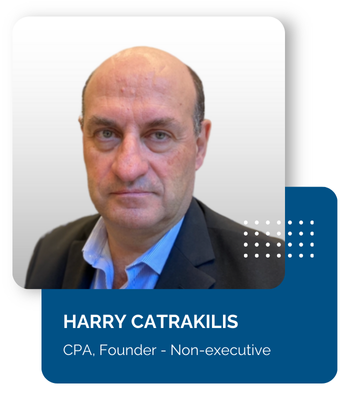
Harry Catrakilis has over 30 years of experience in the practice of public accounting, corporate financial management, and investment banking. He was managing partner of CKH from 2003 until summer of 2018 when main operations were passed on to CEO. This blog was written by and is the candid reflections of Harry Catrakilis.