
Report of Local Government Finances (RLGF): A Complete Guide for Georgia Local Governments
- July 29, 2026
- Posted by: CKH Group
- Category: Government Accounting
Table of Contents
CKH Group is not affiliated with the Georgia Department of Community Affairs (DCA), and individual questions about the RLGF or your submission should be directed to the DCA.
Every year, local governments across Georgia have several financial reporting deadlines to meet. Between preparing for the annual audit, closing the books, filing the Annual Financial Report (AFR), and managing day-to-day operations, it’s easy for another required filing to slip under the radar: the Georgia RLGF (Report of Local Government Finances), an annual filing submitted to the Georgia Department of Community Affairs (DCA).
For many city clerks, finance directors, and government accountants, the RLGF can feel intimidating, especially if it’s your first time completing it or you’ve recently taken over financial reporting responsibilities. Fortunately, once you understand how the report is organized and where the information comes from, the process becomes much more manageable.
This guide explains what the RLGF is, why it’s required, who must complete it, when it’s due, and provides a step-by-step walkthrough of how to complete the report.
What Is the Report of Local Government Finances (RLGF)?
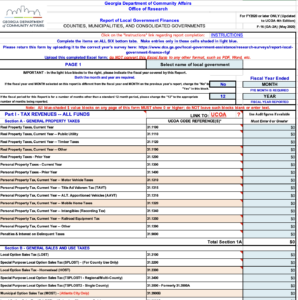
The Report of Local Government Finances (RLGF) is an annual financial report submitted by Georgia local governments to the Georgia Department of Community Affairs (DCA).
Rather than serving as a replacement for your Annual Financial Report (AFR) or audited financial statements, the RLGF summarizes key financial information in a standardized format. This consistency allows DCA to collect comparable financial data from local governments across the state.
The report primarily summarizes information that already exists in your year-end financial statements, including revenues, expenditures, assets, liabilities, debt, and fund balances. This means that if you already have the data prepared and accessible for your other deadlines and responsibilities (such as your audit or AFR), you will likely be able to complete the RLGF without too much difficulty.
Where Is the RLGF Required?
The RLGF is specific to the State of Georgia.
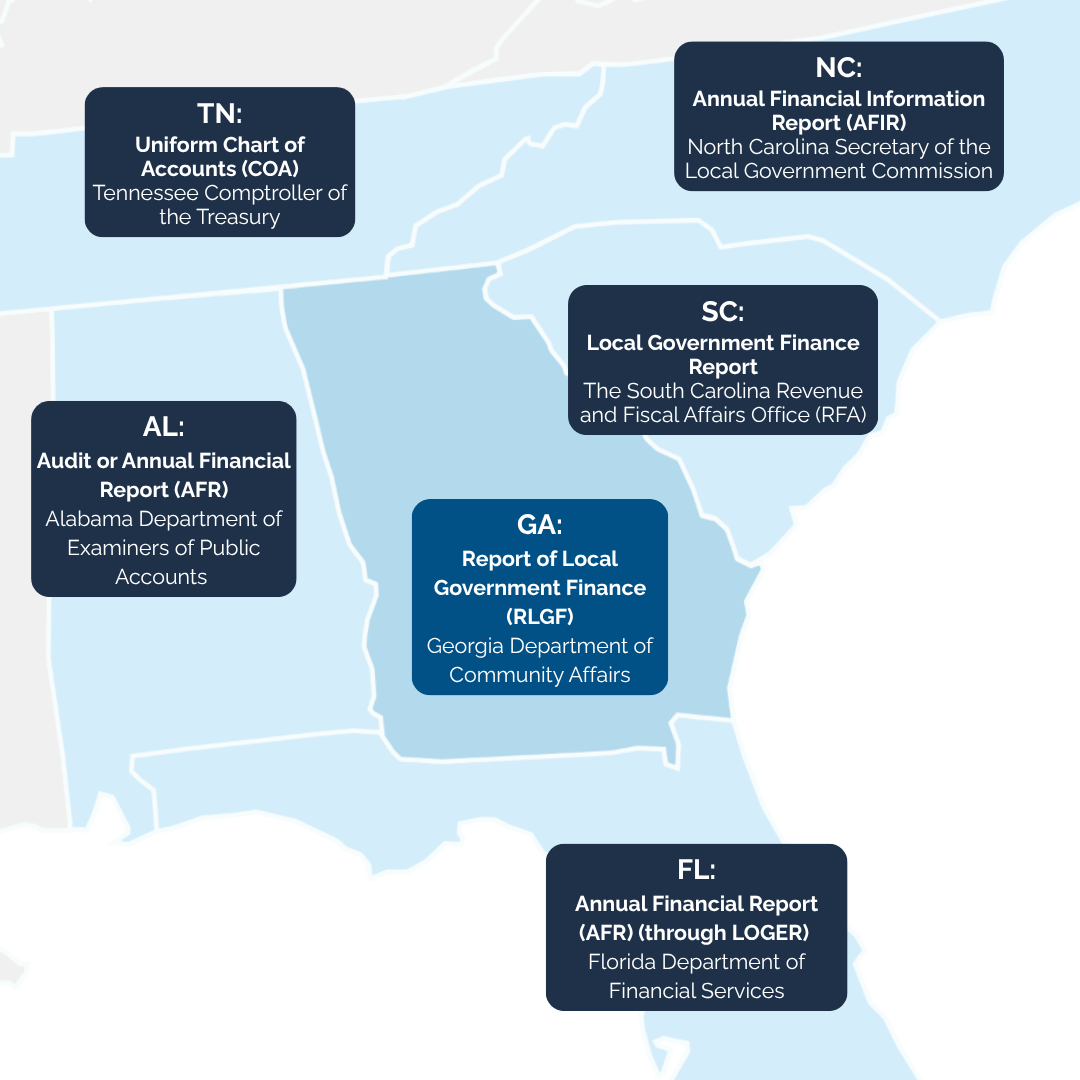
While most states require local governments to submit annual financial information in some form, the Report of Local Government Finances is a Georgia reporting requirement administered by DCA. Other states may require similar reports through their state auditor, comptroller, department of revenue, or another oversight agency, but the forms, deadlines, and reporting requirements vary.
If you are a city clerk or government finance professional outside Georgia, please check your local reporting requirements.
Because this guide focuses on Georgia local governments, all references to the RLGF apply specifically to Georgia’s reporting process.
Why Is the RLGF Required?
Georgia law requires local governments to submit annual financial information to DCA. The standardized information collected through the Georgia RLGF helps:
-
- Monitor the financial health of Georgia’s local governments
- Support statewide financial research and planning
- Provide transparency to citizens
- Supply information used by researchers, legislators, and rating agencies
- Create consistent financial reporting across municipalities and counties
Because every government reports similar information in the same format, the state can more easily compare financial trends across jurisdictions.
Who Must Complete the RLGF?
 The RLGF must be submitted annually by all active Georgia municipalities, counties, and consolidated governments.
If your organization is a local authority (such as a housing authority, hospital authority, or development authority) you generally will not complete an RLGF. Instead, DCA requires local authorities to file an Annual Authority Registration and Financial Report (AARF).
If you’re unsure which reporting requirement applies to your organization, DCA provides guidance through its Government & Authority Reporting webpage, which outlines the reporting requirements for both local governments and authorities.
Within a municipality, the individual responsible for preparing and submitting the RLGF depends on the city’s designated responsible party. In smaller cities, the City Clerk often prepares the RLGF because they may also oversee accounting and financial reporting. In larger municipalities and counties, the report is typically completed by the Finance Director, accountant, controller, or another member of the finance department. Governments that outsource their accounting may also have their external accounting firm prepare the workbook using the municipality’s year-end financial records.
Regardless of who prepares the report, that individual should have access to the government’s finalized financial statements and a strong understanding of the municipality’s year-end financial records. If your municipality does not have a documented process for completing the RLGF, we recommend assigning primary responsibility to the individual who prepares the year-end financial statements or oversees the year-end closing process, as they will typically have the easiest access to the information needed to complete the report accurately.
When Is the RLGF Due?
The RLGF is generally due within six months after the end of your fiscal year. For example, if your fiscal year ends on June 30, your RLGF would be due December 31.
Although six months may seem like plenty of time, completing the report is much easier after year-end closing has been finalized. Although the RLGF can be completed using unaudited year-end financial records, many governments choose to wait until the audit has been completed so they can report final audited balances whenever possible. However, waiting until the deadline often means trying to reconcile balances while simultaneously completing other required filings.
How to Complete the RLGF
Once your fiscal year has ended, completing the RLGF becomes a straightforward process if you work through it systematically.
Step 1: Complete Your Year-End Closing Process
Before beginning the report, ensure your accounting records are as complete as possible.
Ideally, you should have:
-
- Posted all year-end journal entries
- Completed all bank reconciliations
- Recorded adjusting entries
- Closed the fiscal year
- Reconciled fund balances
- Updated debt schedules
- Recorded movement for capital assets
If your audit has already been completed, use the audited financial statements whenever possible.
Step 2: Gather Your Supporting Documents
Before opening the RLGF workbook, collect the financial documents you’ll reference throughout the reporting process.
Most governments will need:
-
- Annual Financial Report (AFR) including audit report
- Trial balance
- General ledger
- Balance Sheet
- Statement of Revenues, Expenditures, and Changes in Fund Balance
- Debt schedules
- Capital asset schedules
- Prior year’s RLGF submission (recommended)
Having these documents readily available can significantly reduce the time spent searching for information while completing the report.
If it is your first time completing this report, having your prior year’s RLGF submission can also be a helpful reference tool. If, for example, you reported a recurring expense on last year’s report but it doesn’t show up on this year’s, it can signal you to double check where you got the number from.
Step 3: Download the Current RLGF Workbook
Each year, DCA provides the current RLGF reporting excel workbook, instructions, and submission guidance through its Government & Authority Reporting website. The RLGF download can be found here.
The workbook contains built-in reporting schedules and instructions that guide you through each section of the report. If you’re uncertain about a particular section, you can hover over any line item with a red corner to get additional guidance. The workbook itself gives plenty of instruction as to where and how to fill it out and how to return it, so be sure to read the document thoroughly. Once completed, the workbook is uploaded through DCA’s online submission portal.
Always download the current reporting workbook for the appropriate reporting year rather than reusing an older version, as reporting requirements and validation rules may change.
Step 4: Complete Each Section of the Workbook
Although the layout of the RLGF workbook may change slightly from year to year, the information it collects remains largely the same. Most sections fall into broad categories such as revenues, expenditures, assets, debt, personnel costs, and fund equity, all of which should be readily available once your year-end financial reporting is complete. Additionally, the capital asset and debt sections are only applicable for enterprise funds, so these may not need to be filled out if unapplicable.
One of the most common questions we hear from city clerks and finance professionals is, “Where do I find these numbers?” The good news is that most of the information can be pulled directly from your Annual Financial Report (AFR), audited financial statements, or other year-end accounting records. In some cases, you’ll need to reference supporting schedules or your general ledger for additional detail.
The RLGF is setup to follow the UCOA (Georgia Uniform Chart of Accounts), and in fact supplies the UCOA code references to each of the sections, which can provide some guidance on matching line items to the trial balance. The table below identifies each major section of the current (2026) RLGF workbook and the source documents you’ll most likely reference when completing it:
| RLGF Section | Most Common Source Document(s) |
|---|---|
| Pg. 1 | |
| PART 1 – TAX REVENUES – ALL FUNDS | Statement of Revenues, Expenditures, and Changes in Fund Balances (governmental funds), Annual Financial Report (AFR), or year-end trial balance/general ledger if additional detail is needed. |
| Pg. 2 | |
| PART 2 – INTERGOVERNMENTAL REVENUES – ALL FUNDS | Statement of Revenues, Expenditures, and Changes in Fund Balances, grant revenue schedules, AFR, or general ledger. |
| PART 3 – SERVICE CHARGES AND OTHER REVENUES – ALL FUNDS | Statement of Revenues, Expenditures, and Changes in Fund Balances or detailed revenue reports from the general ledger. |
| PART 4 – REVENUES FROM PUBLIC UTILITY SYSTEMS AND OTHER ENTERPRISE FUNDS | Statement of Revenues, Expenses, and Changes in Net Position (Enterprise Funds) or enterprise fund income statements. |
| Pg. 3 | |
| PART 5 – GOVERNMENT EXPENDITURES | Statement of Revenues, Expenditures, and Changes in Fund Balances, expenditure reports, or general ledger by function. |
| Pg. 4 | |
| PART 6 – EXPENSES FOR PUBLIC UTILITY SYSTEMS AND OTHER ENTERPRISE FUNDS | Statement of Revenues, Expenses, and Changes in Net Position (Enterprise Funds). |
| PART 7 – CAPITAL ASSETS – ENTERPRISE FUNDS | Capital asset schedule, fixed asset ledger, depreciation schedule, Notes to the Financial Statements. |
| PART 8 – PERSONNEL EXPENDITURES | Payroll reports, general ledger expenditure accounts, expenditure detail reports, or department-level salary and benefit schedules. Some governments may also reference their AFR if personnel costs are summarized there. |
| PART 9 – INTERGOVERNMENTAL PERSONNEL EXPENDITURES | Payroll allocation schedules, grant reimbursement schedules (if applicable), or detailed general ledger accounts identifying personnel costs associated with intergovernmental activities. |
| Pg. 5 | |
| PART 10 – INTERGOVERNMENTAL EXPENDITURES (LOCAL GOVERNMENTS ONLY) | Statement of Revenues, Expenditures, and Changes in Fund Balances, expenditure detail reports, or general ledger accounts for payments made to other governments. |
| Pg. 6 | |
| PART 11 – DEBT OUTSTANDING, ISSUED, AND RETIRED DURING THE FISCAL YEAR | Long-term debt schedule, debt amortization schedules, Notes to the Financial Statements, or year-end bond/loan schedules. |
| PART 12 – CASH AND INVESTMENT ASSETS AT THE END OF THE FISCAL YEAR | Balance Sheet (Governmental Funds), Statement of Net Position (Enterprise Funds), reconciled bank statements, investment schedules, or trial balance. |
| PART 13 – GOVERNMENTAL FUND EQUITY AND PROPRIETARY FUND EQUITY | Balance Sheet (Fund Balances) for governmental funds and Statement of Net Position (Net Position) for proprietary/enterprise funds. |
| PART 14 – DEPENDENT ENTITIES | This is a drop down selection to mark if any dependent authority, district, or other local taxing jurisdiction figures are included in the report (you should also attach this list). |
| PART 15 – CERTIFICATION | It is crucial that you complete this signoff section, as the DCA will not accept it if incomplete. |
Step 5: Review and Submit
Before submitting the report, compare the information entered in the workbook to your year-end financial statements and supporting schedules. If you have a copy of the prior year’s RLGF, it’s also helpful to compare the two filings to identify any significant year-over-year changes that may warrant a second look. While changes in revenues, expenditures, or fund balances are often expected, large or unexpected variances should be reviewed to ensure they are supported by your financial records.
Most importantly, remember that the RLGF is intended to summarize your existing financial information. It is not the place to create new figures, make adjusting entries, or estimate balances. Every amount reported should be traceable to your finalized financial statements or supporting documentation. If you find yourself calculating new numbers or entering figures that don’t reconcile to your source documents, it’s a good indication that something should be investigated before the report is submitted.
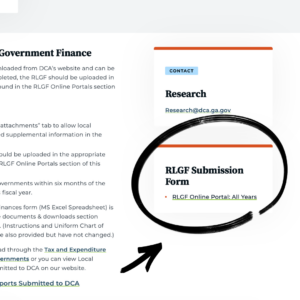
After reviewing, upload the completed file through DCA’s online RLGF submission portal. Be sure to keep a copy of the completed workbook, confirmation of submission, and any supporting schedules. Retaining these records makes next year’s filing significantly easier and provides useful documentation if questions arise later.
RLGF Mistakes and Best Practices
If you’ve never completed an RLGF before, you can expect this task to take anywhere from a few hours to a few days (if not longer) depending on the size and complexity of the government and how organized the financial records are.
Although much of the report involves transferring information from your existing financial statements, you’ll likely spend time verifying balances, locating supporting schedules, becoming familiar with DCA’s workbook, and ensuring each reported amount ties back to your year-end records. You may also have to wait for cross-departmental confirmations or supporting documentation, which is why it is important to allow ample time to complete this document should delays in collecting information arise.
Common Mistakes to Avoid
Even experienced finance professionals occasionally run into reporting issues. Some of the most common include:
-
- Using financial information before year-end adjustments have been completed
- Forgetting to incorporate audit adjustments after the audit is finalized
- Mixing governmental fund information with enterprise fund information
- Pulling balances directly from the trial balance instead of finalized financial statements
- Ignoring validation messages within the workbook
- Waiting until the filing deadline to begin gathering information
Most of these issues can be avoided simply by starting early and using finalized financial statements whenever possible.
Can You Use Unaudited Financial Information for the RLGF?
Yes, the RLGF does not require your audit to be completed before submission. If your audit has not yet been finalized, the report may be completed using your year-end financial records.
However, if audited financial statements are available before filing, it’s generally best practice to use those figures whenever possible. Audit adjustments can affect reported balances, and using finalized numbers helps improve the accuracy of your submission.
Best Practices for Future Filings
Many governments find the process becomes much easier after the first year by establishing a repeatable process.
Consider:
-
- Maintaining a folder containing all supporting schedules used for the RLGF.
- Creating your own source document cheat sheet like the one in this article (but more detailed) to document where each reported figure originates within your financial statements.
- Comparing each year’s filing against the prior year’s submission to identify unexpected changes.
- Having another member of your finance team review the completed workbook before submission.
A little preparation during the current year’s filing can save considerable time when the next reporting cycle begins.
Final Thoughts
The Report of Local Government Finances is an important annual reporting requirement for Georgia municipalities, counties, and consolidated governments. While it may seem overwhelming at first, most of the information required is already contained within your year-end financial records. With a finalized close, organized supporting documentation, and a methodical approach, the filing process becomes significantly more manageable.
If you have any further questions or technical troubles downloading, completing, or submitting, please reach out directly to the Georgia Department of Community Affairs.
If your government needs assistance preparing year-end financial statements, completing the RLGF, or getting audit-ready, working with experienced governmental accounting professionals can help ensure your financial reporting is accurate, timely, and compliant with Georgia’s reporting requirements. Please feel free to reach out to CKH Group if you would like to engage with us, or if you have an open RFP/RFQ you would like us to submit for.
The information provided is for general educational and informational purposes only and does not constitute financial, legal, or tax advice. The tax rules and regulations are complex and subject to change. Before taking any form of action, you should consult your own tax, legal, and accounting advisors who understand your particular situation. CKH Group will not be held liable for any harm/errors/claims arising any tax, legal, or financial consequences you may incur. Whilst every effort has been taken to ensure the accuracy of the contents, we will not be held accountable for any changes that are beyond our control.
Informed Decision Making Starts Here