
Intentional Leadership in Action
- October 17, 2025
- Posted by: Kateryna Kudrenko
- Category: CEO Blog

Intentional Leadership: How Purpose and Clarity Create Good Strategy
Introducing our newest blog series by CKH Group CEO Kateryna (Kate) Kudrenko. Kate shares with us lessons in business, topics that range from leadership lessons and strategy, changes in the business landscape, to mindsets and tips that shape success. This blog offers a candid reflection on all aspects of business from the leader of a CPA firm that has experienced dramatic growth and development in the past few years.
In this first blog, Kate walks us through what leading with intent means, and how it can present in meetings, in day to day, and in strategy. She introduces her own metric for defining a productive meeting as well as the “Fluff test” from the book Good Strategy, Bad Strategy by Richard Rumelt. Overall, she underscores what intentional leadership looks like and what it means to her and her team.
“Last week, a friend at a Fortune 100 company told me their team was fully returning to the office: five days a week starting January 2025. With this being a recurring hot topic, naturally, I had questions.
Now, I’m actually pro-office. I like the energy. I like the focus. While I know that remote or hybrid work offers flexibility that can make top talent more accessible, I do believe that when done well, in-person collaboration can reveal operational blind spots: Who’s overwhelmed? Who’s underutilized? Who’s quietly crushing it and deserves recognition?
But here’s the kicker: My friend said nothing has changed. Even with everyone physically back at their desks, managers aren’t managing any better. There’s no clearer communication, no better workload distribution, no visible leadership presence.
In other words- same people, same patterns, just a different backdrop.
That conversation stuck with me because it underscores something I’ve been thinking about a lot lately: Leadership without intention is just theater. Whether you’re mandating return-to-office, launching a new initiative, or sitting through back-to-back meetings, if there’s no purpose behind it, it’s just activity for activity’s sake.
The Multitasking Test
Speaking of meetings, I had 34 of them last week. Most were under 20 minutes and very productive. One was a marathon three-hour session. All useful, all necessary. But I have a personal metric for whether a meeting is worth the time:
If I’m multitasking during a meeting, I probably shouldn’t be in it.
And if someone else is multitasking? I start asking why. Is the meeting too long? Is it not relevant to them? Do they have so many meetings or so much work that they’re forced to “work through” them?
These aren’t just rhetorical questions; they’re diagnostics. When people start mentally checking out, the answer isn’t “have fewer meetings,” it’s “have better ones.”
It means setting clear expectations with your team as to the agenda and purpose. It also means considering the joking phrase of ‘this could have been an email.’ If you’re hosting a meeting, the first question you should ask is why. What value are you gaining from talking in person or over the phone that you otherwise could not get? What value does each person invited bring or take away by being there?
If the answer is ‘I don’t know’, then it might be time to question the necessity of the meeting.
The Fluff Test
I’ve been reading (and rereading) Good Strategy, Bad Strategy by Richard Rumelt. One of my favorite examples he gives is from a retail bank’s strategy memo:
“Our fundamental strategy is one of customer-centric intermediation.” Translation: We’re a bank. Our strategy is to be a bank.
That’s what Rumelt calls “fluff”. Vague, overused buzzwords dressed up to sound profound. We’ve all seen it. With the rise of everyday use of AI, it’s becoming even more commonplace. And in leadership, it can be dangerous. Because fluff kills clarity, and ambiguity does not assign responsibility.
A good strategy isn’t a slogan or a vibe. It’s three things:
- A clear diagnosis of the challenge
- A guiding policy for how to tackle it
- Coherent actions that support that policy
For example, bad strategy might say: “Our mission is to become a global leader by leveraging innovation, customer-centricity, and operational excellence to deliver value across all verticals.” That sounds impressive, but what does it mean? It’s just a jumble of high-level aspirations with no diagnosis and no direction.
Now compare it to a more actionable strategy: “We’ve identified declining client retention in our mid-market segment as a critical challenge. To address this, we’ll implement a dedicated customer success team, refine onboarding workflows to reduce churn, and invest in CRM tools that provide better insight into usage and satisfaction trends.” You’re not just saying you want to ‘do better’ you are explaining a where, why, and how that you can execute on.
What Intentional Leadership Looks Like
So, here’s my honest take: Whether you’re managing a CPA firm, a global enterprise, or a three-person team; you don’t need more rules, rituals, or routines. You need more intentionality.
If you’re going to ask people to come into the office, give them a reason to want to be there.
If you’re calling a meeting, make it count.
If you’re leading a company, don’t settle for fluff. Say what you mean and do what you say.Leadership isn’t about optics, it’s about outcomes. And outcomes come from purpose, clarity, and daily follow-through, all keys to intentional leadership.” -Kateryna Kudrenko
The above article only intends to provide general information and reflection. It is not designed to provide specific advice or recommendations for any individual. It does not give personalized tax, financial, or other business and professional advice. Before taking any form of action, you should consult a financial professional who understands your particular situation. CKH Group will not be held liable for any harm/errors/claims arising from the blog. Whilst every effort has been taken to ensure the accuracy of the contents, we will not be held accountable for any changes that are beyond our control.
About the Author
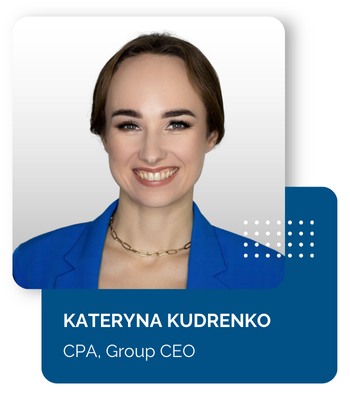
Kate Kudrenko has 15 years of experience in M&A, tax accounting, and compliance and holds a CPA in the state of Georgia. Since joining CKH in 2016 Kate has been involved in every area of CKH business. In 2025 she was promoted to the role of Chief Executive officer, where she is responsible for day-to-day operations, strategic execution, and overall leadership of CKH Group. This blog was written by and is the candid reflections of Kate Kudrenko